The Quantum Secret Inside Your Cells: How Cholesterol Could Power Tomorrow's Gadgets
Tapasya Pandiyan · Sri Chaitanya Techno School (Chennai, Tamilnadu, India)
July 1, 2026
When you hear the word cholesterol, you probably think of doctors, heart health, or routine blood tests. You certainly don’t think of smartphone processors or quantum computers. However, a stunning discovery by scientists at the Institute of Nano Science and Technology (INST) in India has revealed that cholesterol-based materials may become the building blocks of future electronic devices. (Garg et al., 2025). By using cholesterol in a specialized branch of physics called spintronics, researchers are finding ways to build microchips that are smaller and consume far less battery power than the traditional silicon chips we use today. In other words, this common biological molecule might hold the key to the future of computer hardware.
The Silent Crisis in Modern Electronics
Every time you play a graphic heavy game on your phone or charge your laptop, you notice it gets warm. This heat is the fundamental flaw of modern tech.
Traditional computers run on streams of electrical charges – electrons, that is – pushing through tiny silicon tracks. As billions of these electrons jam into microchips, they constantly bump into atoms, creating resistance. This kind of electrical resistance wastes immense amounts of battery power as thermal waste – heat.
Engineers try to make chips smaller to pack more computing power into our devices, but they are reaching a physical limit. As chips get smaller, the harder it is to manage heat. To save our tech from burning out, scientists started to shift their attention from focusing on the charge of an electron to its rotation.
What is Spintronics? (A Quantum Dance!)
Instead of just forcing electrons down a wire, a new field called spintronics takes advantage of an intrinsic quantum property called electron spin.
Imagine every electron as a tiny planet spinning on its axis. Because electrons carry an electrical charge, this rotation gives these electrons a magnetic moment. In quantum physics, an electron can only spin in two opposite directions:
Spin-Up: Think of it as a clockwise rotation
Spin-Down: Think of it as a counter-clockwise rotation
Instead of needing a massive, colliding crowd of electrons to send a signal, spintronics can manipulate and detect these rotations to process and store information (coding “Spin-Up” as a 1 and “Spin-Down” as a 0). Because the electrons don’t have to race down a crowded track, spintronic chips can significantly reduce energy loss – devices heat up less!
The Molecular Gatekeeper: Chiral-Induced Spin Selectivity (CISS)
The hardest part of building spintronic gadgets is managing the spin of the electrons. In a standard copper wire, electrons are a chaotic, unorganized jumble, where half spin up, and half spin down. However, to read and encode data in the binary system, engineers need a filter that lets only one type of spin pass through.
This is where cholesterol steps in as nature’s ultimate gatekeeper, thanks to a phenomenon called Chiral-Induced Spin Selectivity (CISS) (Garg et al., 2025).
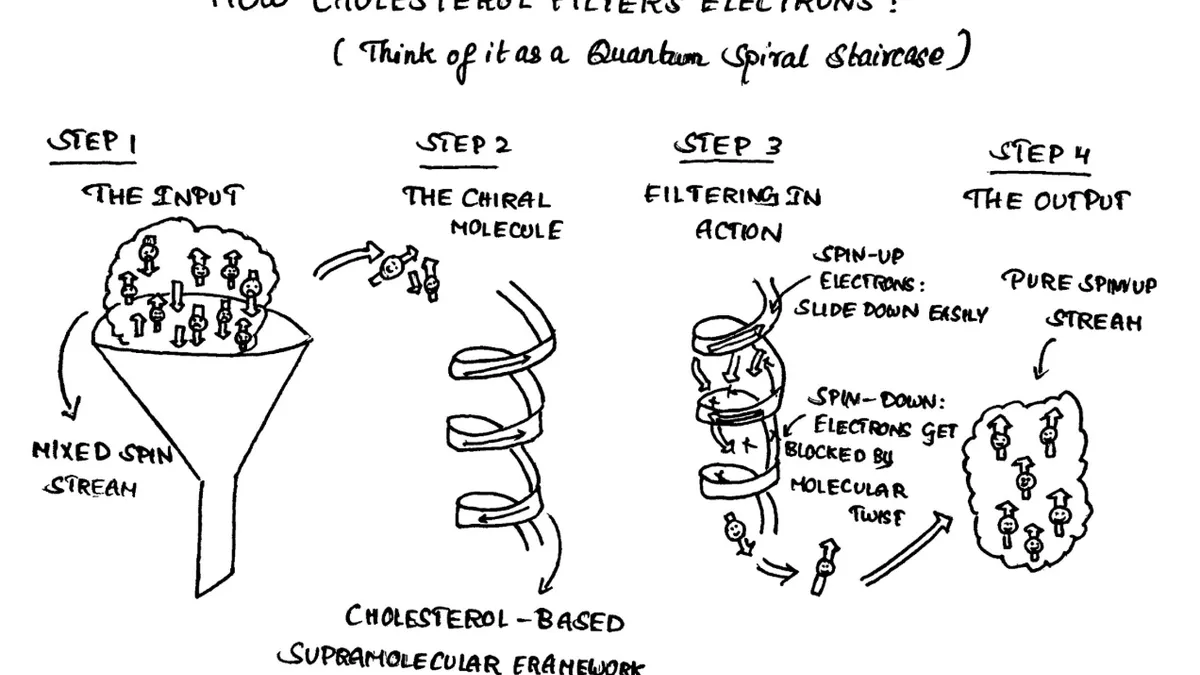
Cholesterol molecules are chiral, meaning they possess a distinct “handedness”. Just like your left and right hands, chiral molecules are mirror images of each other that cannot perfectly overlap. Because of this structure, cholesterol assemblies form a shape like a spiral staircase or a microscopic screw.
When a messy jumble of electrons tries to pass through this twisted molecular staircase, the shape creates an environment that naturally favors one direction of rotation over the other.

(2026). Mechanism of Chiral-Induced Spin Selectivity (CISS) sorting unorganized electrons into unified spin states as they pass through a chiral molecule. [Diagram]. Created by Tapasya Pandiyan.
Nature’s Polarized Sunglasses
Think of a cholesterol layer exactly like a pair of polarized sunglasses. Normal sunlight bounces in every direction and blinds your eyes with glare. Polarized sunglasses block all the chaotic light waves, allowing only clean, organized vertical light waves to pass through so you can see clearly.
As shown in the diagram above, cholesterol acts as polarized sunglasses for quantum electronics. It blocks the unwanted, chaotic rotations and lets a perfectly unified stream of a single spin type exit the other side.
What makes the INST team’s discovery so incredible is that this biological filter can be manipulated with a high degree of control (Garg et al., 2025; Kumar, 2026). By changing external chemical triggers such as adjusting the concentration of metal ions bound to the cholesterol, scientists can actively flip the filter. They can program it to allow spin-down electrons in one moment, and instantly switch it to allow spin-up electrons the next. This gives engineers complete control over quantum data using cheap, sustainable organic components.
Conclusion
By blending the rules of quantum physics with everyday organic biology, researchers are paving the way for molecular hardware. The next time you see a medical report mentioning cholesterol, remember that the substance could one day be running the ultra cool, ultra fast processors inside your next smartphone.
References
- Garg, R., Bisht, P. S., Bhatt, N., Nakka, N., & Mondal, A. K. (2025). Metal-mediated tunable spin-selective transport in cholesterol-based metal-organic supramolecular materials. Chemistry of Materials, 37(16), 6422-6431. https://pubs.acs.org/doi/10.1021/acs.chemmater.5c01302
- Kumar, C. (2026). How cholesterol can power tomorrow’s devices. The Times of India. https://timesofindia.indiatimes.com/science/how-cholesterol-can-power-tomorrows-devices/articleshow/126477047.cms