The Quantum Nose: The Controversial Quantum Theory of Smell
Tapasya Pandiyan · Sri Chaitanya Techno School
August 25, 2026

*This article discusses a hypothesis that is being debated, meaning the facts surrounding the Quantum Theory of Smell is not absolute.*
Introduction
When you walk into a kitchen and smell freshly baked cookies, your brain instantly recognizes the scent. For a long time, science explained this process through a simple “lock-and-key” model: molecules floating through the air have specific shapes, and they fit into matching receptor proteins inside your nose just like a key fits into a lock. Once the right key turns the lock, your nose sends a signal to your brain.
However, this classic shape-based theory has a major puzzle it cannot fully explain. Molecules with completely different geometric structures can sometimes smell identical while other molecules that are almost mirror images of each other can smell entirely different. How does your nose tell the difference?
Enter a radical idea from biophysics: your nose might not just be a shape-sorter; it might act as a quantum detector—a biological system capable of measuring tiny quantum (the smallest possible unit of anything) properties of single particles. Some scientists suggest a hypothesis that says our sense of smell relies on a subatomic phenomenon called electron tunneling, essentially turning our noses into biological quantum spectroscopes.
The Puzzle of Molecular Shapes
To understand why scientists looked beyond simple shapes, consider how we distinguish thousands of different aromas. Traditional biology tells us that humans have hundreds of types of olfactory receptors in the nasal cavity. Yet, we can differentiate an enormous variety of chemical compounds (odorants).
For example, borane molecules (B₂H₆) and ethane molecules (C₂H₆) have strikingly similar physical sizes and geometry, yet borane smells intensely like rotten eggs while ethane is practically odorless. Conversely, benzaldehyde and hydrogen cyanide have completely different structures, yet both produce a distinct bitter almond scent. The lock-and-key model struggles to account for these contrasts, prompting researchers to look at what happens inside the molecule once it docks—specifically, the vibration of its atomic bonds.
What is Electron Tunneling?
In standard physics, if an electron wants to move from point A to point B, it has to travel across the space between them. But quantum mechanics introduces a strange and fascinating rule called quantum tunneling.
Imagine rolling a ball up a hill. If the ball doesn’t have enough energy to reach the top, it rolls back down. In the quantum world, subatomic particles like electrons can act like waves and tunnel through the hill. Because of this wave-like behavior, there is a probability that an electron can simply “disappear” from one side of a hill and “appear” on the other side, even if it didn’t classically have enough energy to climb over it. It tunnels straight through.
In the 1990s, biophysicist Luca Turin proposed that the human olfactory system uses this exact quantum trick to “listen” to the vibrations of a scent molecule.
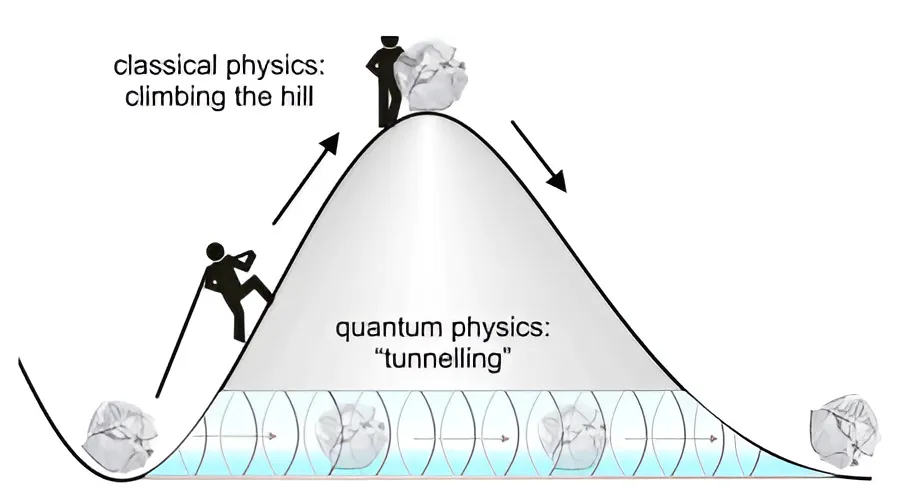
Figure 1. Comparison between classical physics, where a molecule must overcome an energy barrier to trigger a response, and quantum physics, where an electron “tunnels” straight through the barrier (to activate the olfactory receptor). Image credit: Chauhan, M. (2023), “Quantum Tunneling: Crossing Impossible Barriers,” Medium.
The Nose as a Quantum Spectroscope
According to the vibrational theory of olfaction, when an odorant molecule floats into your nose, it docks into an olfactory receptor (in charge of smell). The hypothesis suggests that once the odorant molecule is locked into place, an electron inside the receptor attempts to tunnel across a tiny gap to a target binding site on the receptor protein.
However, there is a catch. In this theory, the energy of the odor molecule’s vibrations must match the energy that the electron needs for it to tunnel across.
Think of it like a musical tuning fork. If you strike a fork tuned to a specific pitch, only a string or object capable of vibrating at that exact frequency will respond and hum along. When an odorant molecule binds in the receptor, its internal chemical bonds vibrate like tiny springs. If the energy of those molecular vibrations matches the energy gap required for the electron to tunnel, the electron uses that vibrational energy to make the jump.
When the electron successfully tunnels across, it sets off a series of chemical signals inside the cell. These signals produce nerve impulses that travel along the olfactory nerve to the brain, where the signals are decoded and interpreted as a particular smell. In short, your nose isn’t just feeling the shape of a molecule; it is subatomically “listening” to how its chemical bonds vibrate.
From Theory to Testing
While theoretical models published in journals like Physical Review Letters have shown that inelastic electron tunneling is physically viable, the theory faces heavy skepticism. Most skepticism arises because this specific electron tunneling process would need to survive in the thermally active (warm), wet, highly fluctuating environment that biological receptors operate in without losing its quantum coherence before the signal is triggered.
To test the theory, researchers have studied “deuterated” compounds—molecules where normal hydrogen atoms are replaced with heavier deuterium isotopes. The physical shape of the molecule remains identical, but the extra weight changes its vibrational frequency.
Results from these experiments remain mixed and actively debated. While studies on fruit flies showed that insects can reliably distinguish between normal and deuterated molecules, human testing has yielded conflicting results. Some human trials suggested participants could detect differences in certain deuterated odors, while other rigorous studies found that humans could not reliably distinguish between the two, leaving the hypothesis open to ongoing investigation.
Conclusion
Our understanding of human biology is constantly evolving as we discover that nature utilizes quantum mechanics for everyday tasks. While debate continues over how much weight should be given to the vibrational theory of smell, the “quantum nose” theory opens up incredible possibilities. More research is necessary to determine whether molecular structure and conventional receptor interactions can fully explain the process of smell, or if electron tunneling actually participates in a major role in recognizing smell.
References
- Brookes, J. C., Hartoutsiou, F., Horsfield, A. P., & Stoneham, A. M. (2007). Could humans recognize odor by phonon assisted tunneling? Physical Revew Letters, 98(3), 038101. https://doi.org/10.1103/PhysRevLett.98.039101
- Costandi, M. (2006, December 12). The quantum mechanics of smell. Neurophilosophy. https://neurophilosophy.wordpress.com/2006/12/12/the-quantum-mechanics-of-smell
- Franco, V., Turin, L., Mershin, A., & Skoulakis, E. M. (2011). Molecular vibration-sensing component in Drosophila melanogaster olfaction. Proceedings of the National Academy of Sciences, 108(9), 3797-3802. https://doi.org/10.1073/pnas.1012293108 4. Mihir. (2025). Quantum tunneling: Crossing impossible barriers. Medium. https://medium.com/@mihir473/quantum-tunneling-crossing-impossible-barriers-917f165fb8ef
- Szczęśniak, D., Drzazga-Szczęśniak, E. A., Kaczmarek, A. Z., & Kais, S. (2025). Quantum smell: Tunneling mechanisms in olfaction. Molecules, 30(24), 4663. https://doi.org/10.3390/molecules30244663