The "Google Maps" of the Brain
Zeynal Emiraslanov · School No. 28 Named After Polad Hashimov
September 5, 2026
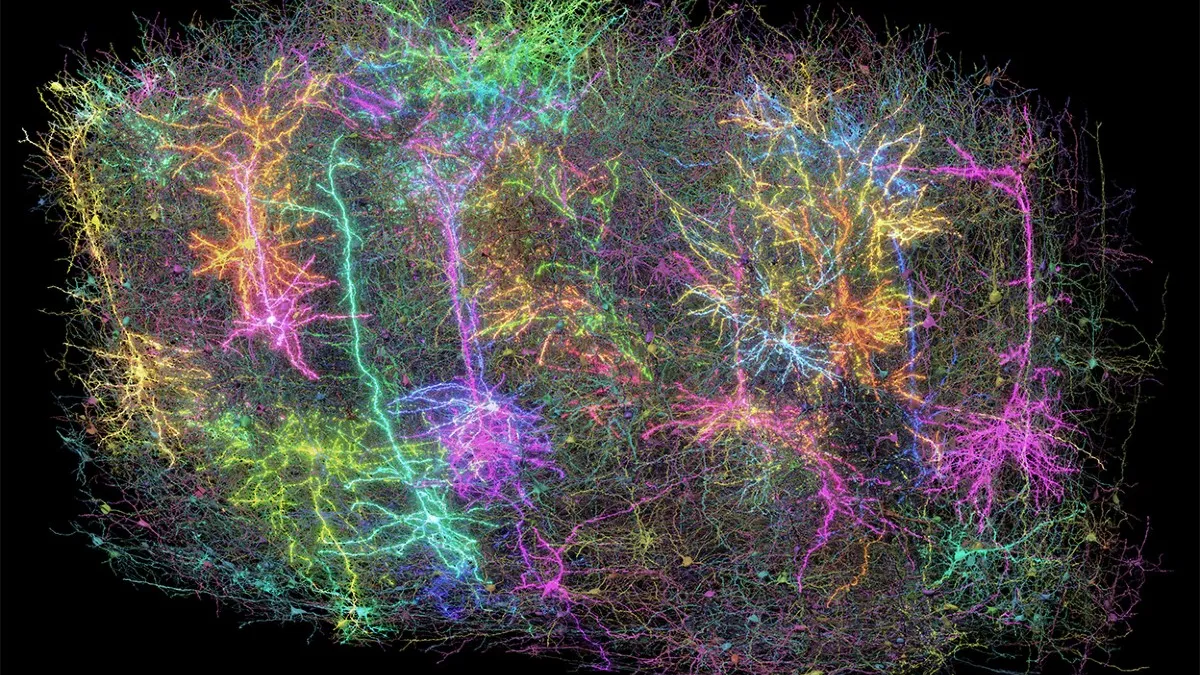
Imagine the brain as a city. In this city, 86 billion neurons reside. Each neuron connects with thousands of other neurons, resulting in trillions of synaptic pathways. Scientists have already begun the task of mapping this magnificent city, and the initial results are magnificent.
What is a neuronal map and why is it so important?
A neuronal map, scientifically known as a “connectome”, is a complete diagram of all nerve connections in our brain. A neuronal map is more than just a static picture of the brain; it is a functional tool that can help explain how our thoughts, emotions, and memories are generated through specific neural circuits.
In 2024, a first in the science world occurred: the complete map of an adult fruit fly’s brain was charted. This map encompassed 139,255 neurons and over 50 million connections.¹ But why was a fruit fly’s brain mapped instead of humans? The structural principles in a fly’s brain resemble many parts of a human brain. That is, despite major differences in size and complexity, fruit flies share some fundamental principles in how the brain is organized as humans. So, it offers an invaluable model for understanding our brain.
Now, scientists are turning their sights to the next target: the human brain. Currently, scientists from 25 countries are working within the framework of the 25-year International Primate Brain Mapping Consortium to prepare a cellular-level map of the human brain.²
How Can This Map Help Us in the Future?
1. A New Era of Personalized Medicine
With neuronal maps, doctors will be able to know the individual characteristics of each patient’s brain. Diseases like Alzheimer’s, Parkinson’s, and autism that are viewed as disruptions of brain connections can be understood further, with maps showing which specific connections a disease has damaged. This will allow treatment to be targeted precisely at that point.
Furthermore, “Digital Twin Brain” technology is already becoming a reality. A Digital Twin Brain is a personalized, dynamic computer model that simulates an individual’s brain activity. It combines a person’s own brain scans (structure) and functional data to create a virtual replica. This allows doctors to safely test treatments, predict disease progression, and plan surgeries virtually before applying them to the patient. Japanese scientists have created a system capable of predicting a person’s behavior with 90% accuracy by converting their brain connections into a computer model.³ This means psychiatric treatments can be specifically tailored to each patient.
2. Revolution in Brain Surgery
Currently, while removing tumors, surgeons keep the patient awake and send small electrical impulses to the brain to test which areas can be safely removed. A neuronal map will make this process safer—surgeons will know before surgery which areas can be touched and which cannot. This can significantly reduce the risk of damage to areas responsible for speech and movement, helping surgeons preserve a patient’s quality of life.
Interesting Facts:
- The Julich Brain Atlas is a high-resolution 3D brain map developed at Forschungszentrum Jülich in Germany. It replaces the Brodmann map, which is over 100 years old. Built from 10 different brains, it is a probabilistic atlas that reflects individual differences. It currently covers over 200 brain areas, is continuously updated, and is part of the EBRAINS platform. By combining brain structure, connections, and function in a unified framework, this atlas serves as a crucial tool for both scientific research and clinical applications. The Julich Brain Atlas has already mapped over 200 brain regions, and this data is publicly available to scientists worldwide via the internet.⁴˒⁵
- Recent research shows that many of the connections in our brain act as “noise“.⁶ In other words, the most crucial data for brain function is hidden in a small fraction of the connections. This discovery can significantly accelerate the mapping process.
How Long Must We Wait?
There is no unified consensus among scientists regarding when a complete map of the human brain will be ready. Nevertheless, based on rapid advancements in artificial intelligence and microscopy technologies, some leading researchers predict that this could become possible within the next 5 to 10 years.⁷ If this happens, it would mark the beginning of one of the greatest revolutions in medical history. In the near future, neurological diseases may no longer be viewed as incurable, but rather as conditions with a precisely known location on the map.
References
- Dorkenwald, S., Matsliah, A., Sterling, A. R., Schlegel, P., Yu, S. C., McKellar, C. E., Lin, A., Costa, M., Eichler, K., Yin, Y., Silversmith, W. M., Schneider-Mizell, C. M., Jordan, C. S., Brittain, D., Halageri, A., Kuehner, K., Ogedengbe, O., Morey, R., Gager, J., … Seung, H. S. (2024). Neuronal wiring diagram of an adult brain. Nature, 634, 124–138. https://doi.org/10.1038/s41586-024-07558-y
- Chinese Academy of Sciences. (2025, November 6). China launches ambitious collaboration to map primate brains—including ours. https://english.cas.cn/newsroom/cas_media/202511/t20251106_1096131.shtml
- Takahashi, Y., Soda, T., Tomita, H., & Yamashita, Y. (2026). Digital twin brain: Generating multitask behavior from connectomes for personalized therapy. BME Frontiers, 7, Article 0231. https://doi.org/10.34133/bmef.0231
- Amunts, K., Mohlberg, H., Bludau, S., & Zilles, K. (2020). Julich-Brain: A 3D probabilistic atlas of the human brain’s cytoarchitecture. Science, 369(6506), 988–992. https://doi.org/10.1126/science.abb4588
- EBRAINS. (2026). EBRAINS at the Hannover Messe. https://ebrains.eu/news-and-events/2026/ebrains-at-the-hannover-messe
- Pirolo, A. (2026). Pruning the connectome: Most brain connections are dispensable for circuit identity. Zenodo. https://doi.org/10.5281/zenodo.20368768
- Helmstaedter, M. (2026). How to obtain a complete human connectome at synaptic resolution within the next decade. Zenodo. https://doi.org/10.5281/zenodo.19697471
- ANCHOR Human Brain Atlas. (2026). ANCHOR Human Brain Atlas. IIT Madras. http://anchor.humanbrain.in/
- MICrONS Consortium. (2021). Functional connectomics spanning multiple areas of mouse visual cortex. Nature, 640, 435–447. https://doi.org/10.1038/s41586-025-08790-w